Cursed under the feat of Behemoth (Genesis 3:14)
The curse of the serpent in Genesis 3:14 may be read both literally and symbolically, portraying the serpent not merely as an animal but as a fallen heavenly being who, through deception, becomes the archetypal “dust-eater” and progenitor of death. The imagery of crawling and eating dust reflects ancient idioms of humiliation while also pointing to a deeper theological reality: the serpent ushers death into the world and assumes the role of the mouth of Sheol. The phrase “cursed above all livestock” creates a symbolic contrast with behemah (beast) and ultimately with Behemoth in Job 40, the great dust-treading creature, suggesting the serpent is placed beneath the feet of God’s beast—trampled into the dust, he is cursed to consume. Within the biblical metanarrative, the serpent is the archetype of Death and Hades until the final judgment, when the Ancient Serpent, Death, and Hades are cast into the Lake of Fire.
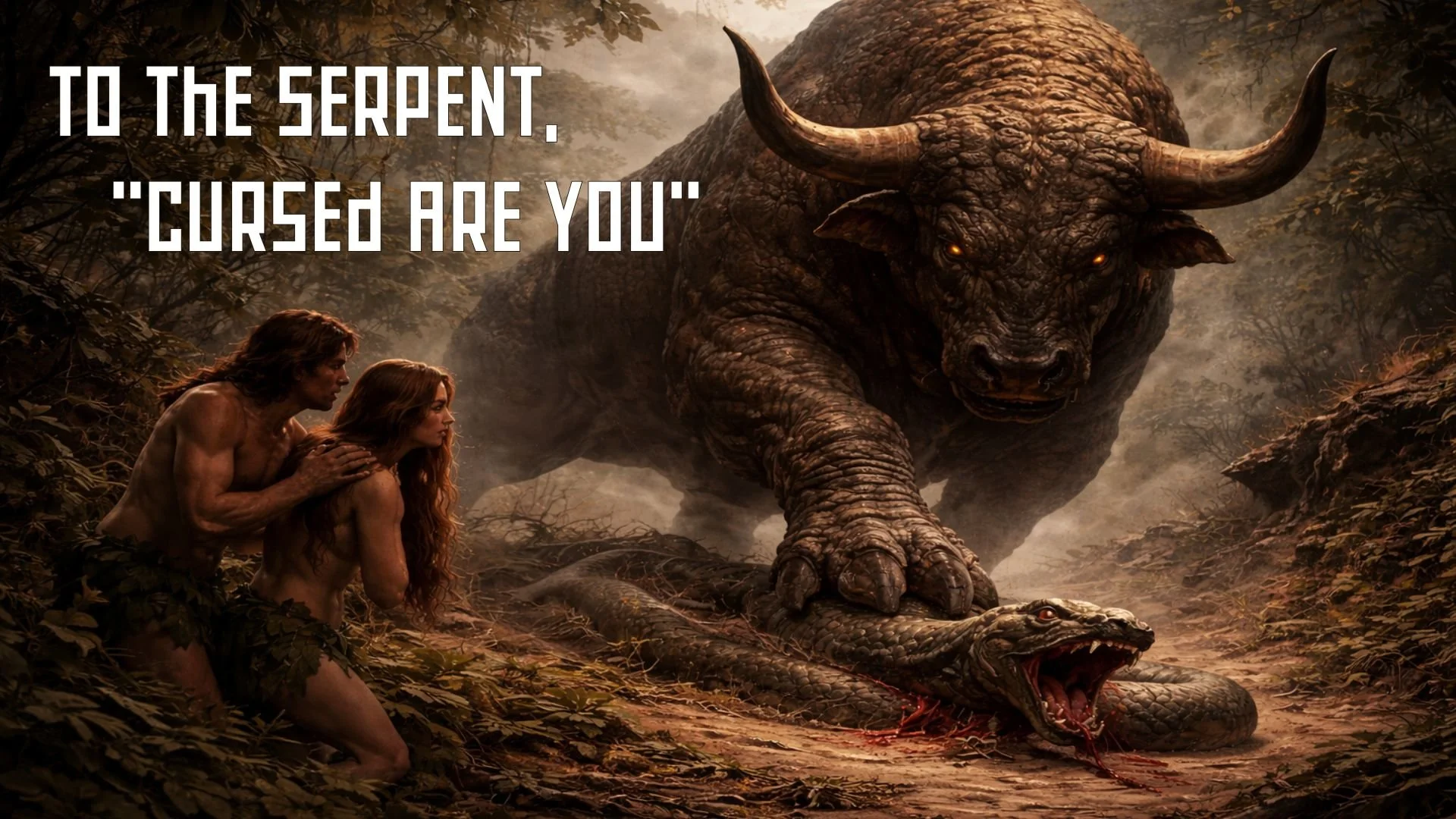
What does it mean in Genesis 3:14 that the serpent is cursed above all livestock and beasts of the field, and are there other biblical references to a curse upon cattle? The questioner notes a connection to my video on Jude 9, where I explain the serpent as the dust-eater.
The words spoken to the serpent are to be read literally and symbolically. Within the narrative, the serpent is depicted as an animal in juxtaposition with other animals, including livestock or cattle (Gen 3:14; cf. Gen 3:1). The fact that the serpent alone receives this distinction suggests that the animal world itself has fallen under sin’s curse as a consequence of sin that extends to creation itself (Gen 3:17–18; Rom 8:20–22).
In ancient Semitic cultures, crawling on your belly and eating dust was an idiomatic expression of defeat and humiliation (cf. Ps 72:9; Isa 49:23; Mic 7:17), pointing to the serpent’s radical degradation. The creature that once moved freely is now forced to slither along the ground. I don’t think it’s merely that; you can find out more in my video Why did the Devil want the body of Moses? (Jude 9). In short, the serpent has inherited the identity of the one who eats death, the death-eater, and the mouth of Hades (Gen 3:19; cf. Isa 5:14; Rev 6:8).
I’m also not sure the text should be interpreted as a curse in the performative sense, and I’ve mentioned this elsewhere. The LORD does not say to the serpent, “I curse you,” but notes indicatively, “cursed are you…” (Gen 3:14), effectively meaning “you have been laid under a curse.” I would argue that the serpent cursed himself or that he is cursed as a consequence of his actions, by defying his natural position—within the narrative, as a serpent (Gen 3:1), but within the metanarrative of Scripture, as one of God’s holy ones of heaven (cf. Job 1:6; 2:1; Ezekiel 28:14).
Where this gets particularly interesting is when we consider what happens when this holy one of heaven (the serpent) defies God by deceiving Eve (Gen 3:4–5). He inspires death coming into the world (Gen 3:19; cf. Rom 5:12), becoming the dust/death-eater. Then, as the one who consumes death, he now comes under the Behemoth. The common Hebrew word for cattle or livestock is behemah, meaning “large animal” or “beast” (Gen 3:14). Behemoth, from the same root, is used uniquely in Job 40:15 to refer to a beast of supernatural or archetypal proportions.
You may find it a stretch to say that a common word for cattle may denote a connection to Behemoth, and you would be right. But notice some of the symbolism here. The Behemoth is the great beast that treads on the dust of the ground with insurmountable strength (Job 40:15ff). In 19, “He is the first of the works of God,” and “the mountains yield food for him” (20), in context, a possible reference to the mountain of God and its Garden imagery (cf. Ezek 28:13–16). Thus, the Behemoth is present, at least conceptually, at the time of the events in question.
To say, then, that the serpent defied his natural position is to say he is cursed apart from those who trample the dust. Another way to say that is to say he is cursed under the feet of Behemoth. He is the dust-eater; therefore, he is trampled into the dust by God’s great beast. More interpretively: Behemoth is the archetype of the beast of the field or the wilderness. The Serpent is the archetype of Death and the Grave (Sheol/Hades).
There is also a cosmological element to this. The earth, including the wilderness, is the liminal space between heaven and earth (i.e., Sheol; Gen 2:7; 3:19; Job 7:9). Humans (and all living things) live in the tension between God in heaven and death in the belly of the earth, the grave (cf. Eccl 3:20; Heb 9:27). The Devil, trampled under the feet of Behemoth, is not yet in the grave, but is appointed as the mouth of the grave—the one who ushers the living into death in Sheol—all the days of his life (Gen 3:14), that is, until the end when the Ancient Serpent, with Death and Hades, is cast into the Lake of Fire (Rev 20:10ff).
