Who is Melchizedek in the Bible?
Melchizedek in Genesis is a historical priest-king of Salem who worshiped the same God as Abraham. Yet his unusual combination of kingship and priesthood, his lack of genealogy, and his blessing of Abraham became the seedbed for later theological reflection. Psalm 110 develops that figure into a royal-priestly model tied to Israel’s kingship, and the New Testament, especially Hebrews, draws on that tradition typologically to explain the superiority and permanence of Christ’s priesthood over the Levitical system. Early Jewish and Christian interpretations took Melchizedek’s significance in different directions. Second Temple sources, including material associated with the Dead Sea Scrolls, sometimes portray him as an exalted heavenly or eschatological figure associated with judgment, atonement, and final deliverance, whereas early Christian writers treat him as a type pointing forward to Christ rather than as a divine manifestation. Taken together, the biblical and Second Temple material portray Melchizedek as a historical figure whose literary presentation and later interpretation provided a conceptual way of articulating Christ’s unique priestly and royal authority.
The name Melchizedek appears only twice in the Old Testament, in Genesis 14:18 and Psalm 110:4, and eight times in the New Testament, all in Hebrews, where the author quotes or refers to Psalm 110:4. The name itself most naturally means “king of righteousness,” while his title as king of Salem is commonly understood as “king of peace.” The pairing of righteousness and peace points to the messianic expectations and helps explain why Melchizedek is an important figure in the book of Hebrews and New Testament theology. The name itself reflects a common ancient Near Eastern pattern in which personal names contain references to deity or divine attributes.
The Historical Melchizedek in Genesis
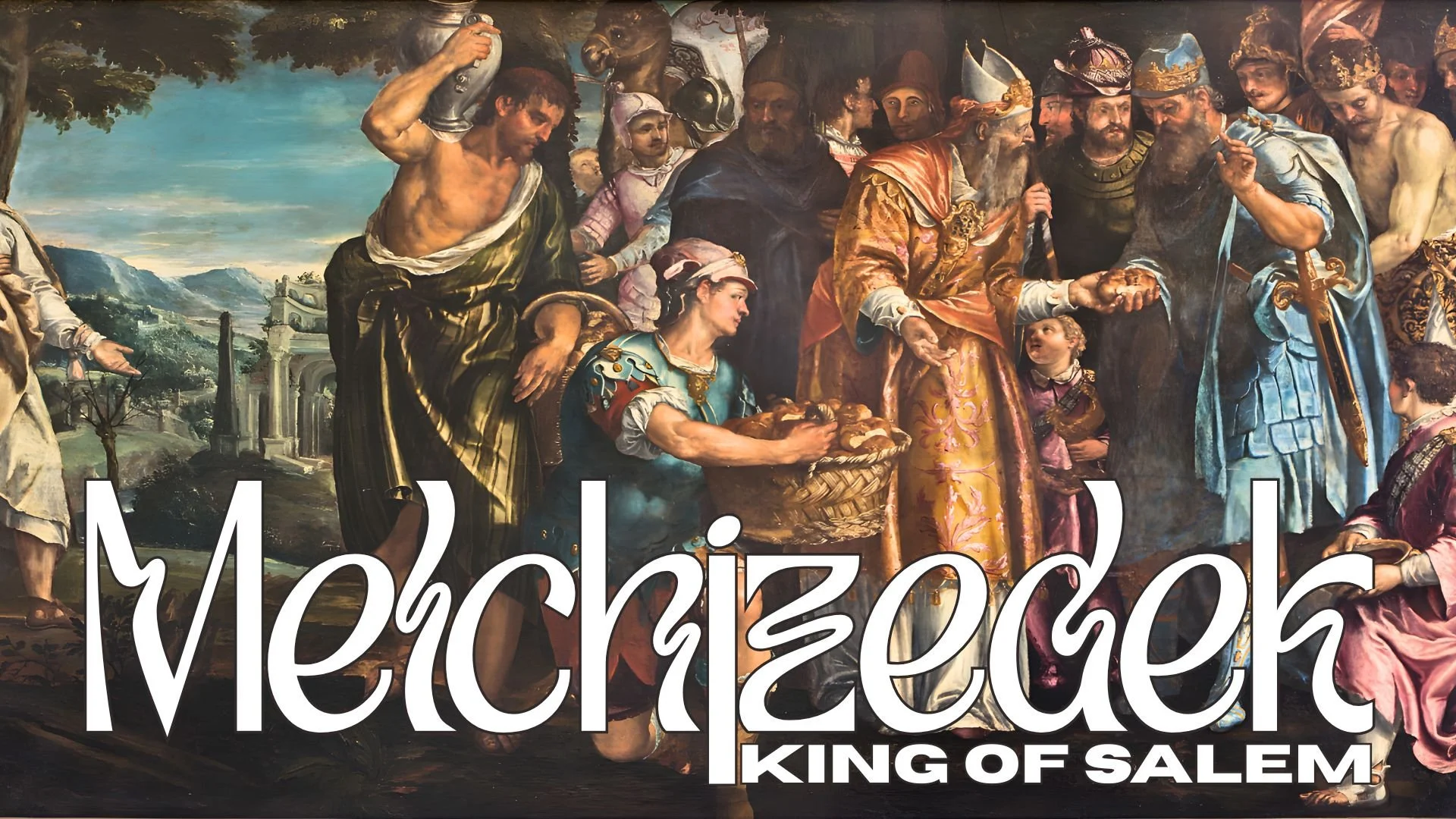
In Genesis 14:8–20, Abraham meets Melchizedek as part of a larger narrative recounting his encounter with the king of Sodom. This is a deliberate contrast between the two figures. Melchizedek is introduced as king of Salem, most likely Jerusalem (cf. Ps 76:3; Josephus, Antiquities I.180), and as priest of God Most High, El Elyon, who is described as the creator of heaven and earth. The combination of kingship and priesthood was not unusual in the ancient Near East. Phoenician inscriptions, for example, describe rulers such as Tabnit and Eshmuneser as both kings and priests. Melchizedek brings bread and wine, blesses Abraham in the name of God Most High, and receives a tithe from him. The narrative reflects an encounter between the nomadic faith of the patriarchs and the established religious life of the city. In the biblical context, God Most High is identified with Yahweh (Gen 14:22). Thus, this episode serves as a sign of Yahweh’s approval and encouragement for Abraham.
Melchizedek should be understood first as a historical figure. He is presented as a real human king, ruling a real city and serving as a priest within that context. This rules out the idea that he is merely a Christophany or other divine manifestation, though his typological significance should not be underplayed. In Scripture, divine appearances are not often given personal names; rather, they are described by titles such as “the angel of the LORD.” Melchizedek, by contrast, has a personal name and a role as a political and religious leader of a historic city, which entails ordinary human responsibilities. His name itself is consistent with older Canaanite naming patterns, as he likely came from the Canaanite world rather than from Abraham’s own lineage. Yet the text portrays him as worshiping the same God as Abraham and as blessing him in that name, suggesting genuine devotion to the true God outside Abraham’s immediate family line.
Salem is traditionally identified as Jerusalem. This connection predates the existence of Israel by centuries. The city’s name likely derives from “foundation of Shalem,” a deity associated with peace in the ancient Near East. Before Israel’s conquest, El Elyon appears to have been recognized as the chief deity of pre-Israelite Jerusalem. When Israel later captured the city, the name and authority associated with El Elyon were attributed to Yahweh. In this sense, Melchizedek represents the establishment of Yahweh as the supreme God in pre-Israelite Jerusalem.
Melchizedek in the Enthronement Psalm
The second Old Testament reference appears in Psalm 110:4. The psalm is generally understood as an enthronement song associated with a Jerusalemite ruler, likely from the early period of Israelite kingship. It contains two divine declarations affirming both royal authority and priestly status. The ruler is declared to be “a priest forever after the manner of Melchizedek.” The precise meaning of this phrase is debated, as it may indicate similarity, succession, or association rather than a formal priestly order. The text likely reflects an early tradition in which Israel’s kings, beginning with David, regarded themselves as inheriting a priest-king pattern associated with Jerusalem prior to Israel’s conquest. This connection between kingship and priesthood did not continue formally in Judah, since no later king is explicitly called a priest (although priestly actions are occasionally associated with figures such as David and Solomon). The title “priest forever” does not reappear until 1 Maccabees 14:41.
Second Temple speculation did not invent Melchizedek’s significance; rather, it intensified existing biblical associations, eventually contributing to interpretations that elevated him to a messianic or heavenly figure. This elevation sometimes led to the conflation of Melchizedek with other biblical “prince” or representatives, particularly within angelic or divine council scenarios, as seen in later Jewish literature, such as 1 Enoch. Within the biblical text itself, however, Melchizedek preserves an earlier pattern in which a single person could be king and priest, an idea that later became central to messianic expectation and provided the conceptual background for later theological reflection.
Melchizedek in the New Testament
Melchizedek’s primary biblical importance comes from the New Testament. The Book of Hebrews applies Psalm 110 directly to Christ, describing Jesus as appointed “a priest forever after the order of Melchizedek.” The argument of Hebrews 7:1–10 depends on Melchizedek’s superiority to Abraham, demonstrated through his blessing of Abraham and Abraham’s giving of a tithe. Because Levi descends from Abraham, the Levitical priesthood is subordinated to the priesthood represented by Melchizedek. Melchizedek’s theological purpose is evident in his priesthood, which is the basis for the superiority and permanence of Christ’s eternal priesthood (contra the temporary nature of the Levitical priests). The New Testament indeed compares Melchizedek to Christ, but the direction of the comparison matters. The point is not that Jesus is like Melchizedek in essence, but that Melchizedek functions analogically to explain Christ’s superior priesthood.
Early Christian interpretation strengthened this connection. Writers such as Cyprian (Cyp., Ep. 63.3) saw Melchizedek as a type of Christ, particularly in the offering of bread and wine and the act of blessing. Just as Melchizedek blessed Abraham with bread and wine, Christ offered his body and blood as the ultimate priestly sacrifice. The typological reading informed early Christian sacramental reflection and the development of high Christology, while still maintaining that Melchizedek himself was a historical person rather than Christ appearing in advance.
Further, the typological function depends in part on the silence of Genesis itself. Unlike other priestly figures in Scripture, Melchizedek appears without genealogy, recorded birth or death, or lineage. Hebrews makes deliberate use of the silence, describing him as “without father or mother, without genealogy, without beginning of days or end of life” (Heb 7:3). The point is not likely that Melchizedek was an eternal being, but that he is described in a way that allows for comparison with Christ. He is “made like the Son of God” (Heb 7:3), (a prefiguration rather than an incarnation). As a king who held both royal and priestly offices and who worshiped the true God outside Israel’s later priestly structures, Melchizedek is a fitting prototype pointing toward Christ’s superior priesthood.
Jewish interpretation during the Second Temple period developed Melchizedek’s role in several directions. Josephus presents him as a historical Canaanite ruler and priest, translating his name as “righteous king” and attributing to him the founding of the temple. Philo regarded him as a historical figure but also interpreted him symbolically as representing right reason and divine wisdom. In this reading, Melchizedek is a historical king and also a philosophical exemplar of a ruler governed by divine wisdom rather than force.
Melchizedek in the Dead Sea Scrolls
The Dead Sea Scrolls and other Qumran texts shed more light on Melchizedek. In Genesis Apocryphon (1QapGen) 22, the Genesis account is retold with minimal notable differences. However, in the Melchizedek document (11QMelch), Melchizedek assumes an eschatological role associated with an eternal Jubilee, restoration, and final judgment. Although the text’s fragmentation makes firm conclusions difficult, it is clear that Melchizedek is portrayed as a leader of the forces of good and associated with end-time liberation, a portrayal that also suggests christological typology. In the document, Melchizedek is strikingly different from the biblical account in Genesis. The document is built around Jubilee imagery drawn from Leviticus and Deuteronomy. Rather than depicting him primarily as the earthly priest-king of Genesis, the text reimagines Melchizedek as a heavenly figure who performs priestly expiation, whose role is tied to the final jubilee year, when release is secured for the righteous through the forgiveness of sins.
In this way, Melchizedek is granted remarkable authority within the divine assembly, is given the title elohim, and functions as an agent of divine judgment against Belial and his forces. Biblical passages that describe God judging among the heavenly assembly are interpreted within the text as referring to Melchizedek’s eschatological activity, reflecting a broader Second Temple expectation of a principal heavenly mediator who acts as God’s appointed representative in final judgment and vindication. Some Second Temple Jewish traditions elevated figures such as Melchizedek to exalted heavenly or semi-divine roles, sometimes described by modern scholars as “second Yahweh” figures, illustrating how speculation about exalted angelic or heavenly mediators developed within this period (cf. 1 Enoch).
This portrayal of Melchizedek as a heavenly redeemer has no direct precedent in the Old Testament, yet it provides important background for later interpretation. Because pre-Christian Jewish tradition could conceive of Melchizedek as an exalted priestly figure associated with atonement and end-time deliverance, the author of Hebrews could plausibly use Melchizedek typology to describe Christ’s priesthood as transcending ordinary genealogical limitations. The Qumran material, therefore, illustrates how Second Temple Jewish speculation formed part of the conceptual world in which early Christian claims about Christ’s unique priesthood and authority were articulated. The New Testament ultimately redirects this line of interpretation away from Melchizedek himself and toward Christ alone. Neither the Old Testament nor Hebrews claims that Melchizedek was eternal or divine; rather, Second Temple texts exploit the literary silence of Genesis (no genealogy, no recorded death) to create a fictitious yet symbolic character not present in the biblical text.
Resources
Allen, David L. Hebrews. The New American Commentary. Nashville, TN: B & H Publishing Group, 2010, 437–438.
Clements, R. E. God and Temple: The Idea of the Divine Presence in Ancient Israel. Eugene, OR: Wipf & Stock, 2016, 43–44.
Cyprian of Carthage. The Epistles of S. Cyprian, with the Council of Carthage, on the Baptism of Heretics. A Library of Fathers of the Holy Catholic Church. Oxford; London: John Henry Parker; J. G. F. & J. Rivington, 1844, 182–184.
Fitzmyer, Joseph A. The Dead Sea Scrolls and Christian Origins. Studies in the Dead Sea Scrolls and Related Literature. Grand Rapids, MI; Cambridge, U.K.: William B. Eerdmans Publishing Company, 2000, 38–39.
Fruchtenbaum, Arnold G. “Foreword.” In Discovering the Mystery of the Unity of God: A Theological Study on the Plurality and Tri-Unity of God in the Hebrew Scriptures. San Antonio, TX: Ariel Ministries, 2010, 259.
Hamilton, James M., Jr. Typology: Understanding the Bible’s Promise-Shaped Patterns: How Old Testament Expectations Are Fulfilled in Christ. Grand Rapids, MI: Zondervan Academic, 2022, 68–69.
Heiser, Michael S. Angels: What the Bible Really Says about God’s Heavenly Host. Bellingham, WA: Lexham Press, 2018, 121.
———. Demons: What the Bible Really Says about the Powers of Darkness. Bellingham, WA: Lexham Press, 2020, 101.
———. “Melchizedek, Part 1a.” The Naked Bible Podcast, episode 166. July 9, 2017. Podcast audio. https://nakedbiblepodcast.com/podcast/naked-bible-166-melchizedek-part-1a/.
———. “Melchizedek, Part 1b.” The Naked Bible Podcast, episode 167. July 15, 2017. Podcast audio. https://nakedbiblepodcast.com/podcast/naked-bible-167-melchizedek-part-1b/.
———. “Melchizedek, Part 2.” The Naked Bible Podcast, episode 168. July 22, 2017. Podcast audio. https://nakedbiblepodcast.com/podcast/naked-bible-168-melchizedek-part-2/.
———. “Melchizedek, Part 3.” The Naked Bible Podcast, episode 170. August 5, 2017. Podcast audio. https://nakedbiblepodcast.com/podcast/naked-bible-170-melchizedek-part-3/.
Huffmon, H. B. “Shalem.” In Dictionary of Deities and Demons in the Bible, edited by Karel van der Toorn, Bob Becking, and Pieter W. van der Horst, 756. Leiden; Boston; Köln; Grand Rapids, MI; Cambridge: Brill; Eerdmans, 1999.
Hurtado, L. W. “Monotheism, Principal Angels, and the Background of Christology.” In The Oxford Handbook of the Dead Sea Scrolls, edited by Timothy H. Lim and John J. Collins, 554–555. Oxford Handbooks. Oxford: Oxford University Press, 2010.
Kaiser, Walter C., Jr., et al. Hard Sayings of the Bible. Downers Grove, IL: InterVarsity Press, 1996, 120–121.
Reiling, J. “Melchizedek.” In Dictionary of Deities and Demons in the Bible, edited by Karel van der Toorn, Bob Becking, and Pieter W. van der Horst, 560–563. Leiden; Boston; Köln; Grand Rapids, MI; Cambridge: Brill; Eerdmans, 1999.
