Jesus in Joshua 10 and the Kings Against God’s Kingdom
The defeat and burial of the Amorite kings in Joshua 10 is interpreted as part of a larger biblical pattern in which rebellious rulers who claim legitimacy apart from God are publicly humbled and removed, establishing God’s rule in the land, and this event functions typologically in relation to the resurrection of Jesus, where the imagery of the sealed cave is reversed as the true righteous king enters death and emerges alive in vindication and exaltation. This continuity between Joshua and Jesus reflects a broader biblical theme in which earthly kingdoms oppose God’s kingdom and are ultimately judged, while God establishes an eternal reign through his anointed king, Jesus, fulfilling in final form what earlier events in Israel’s history anticipated.
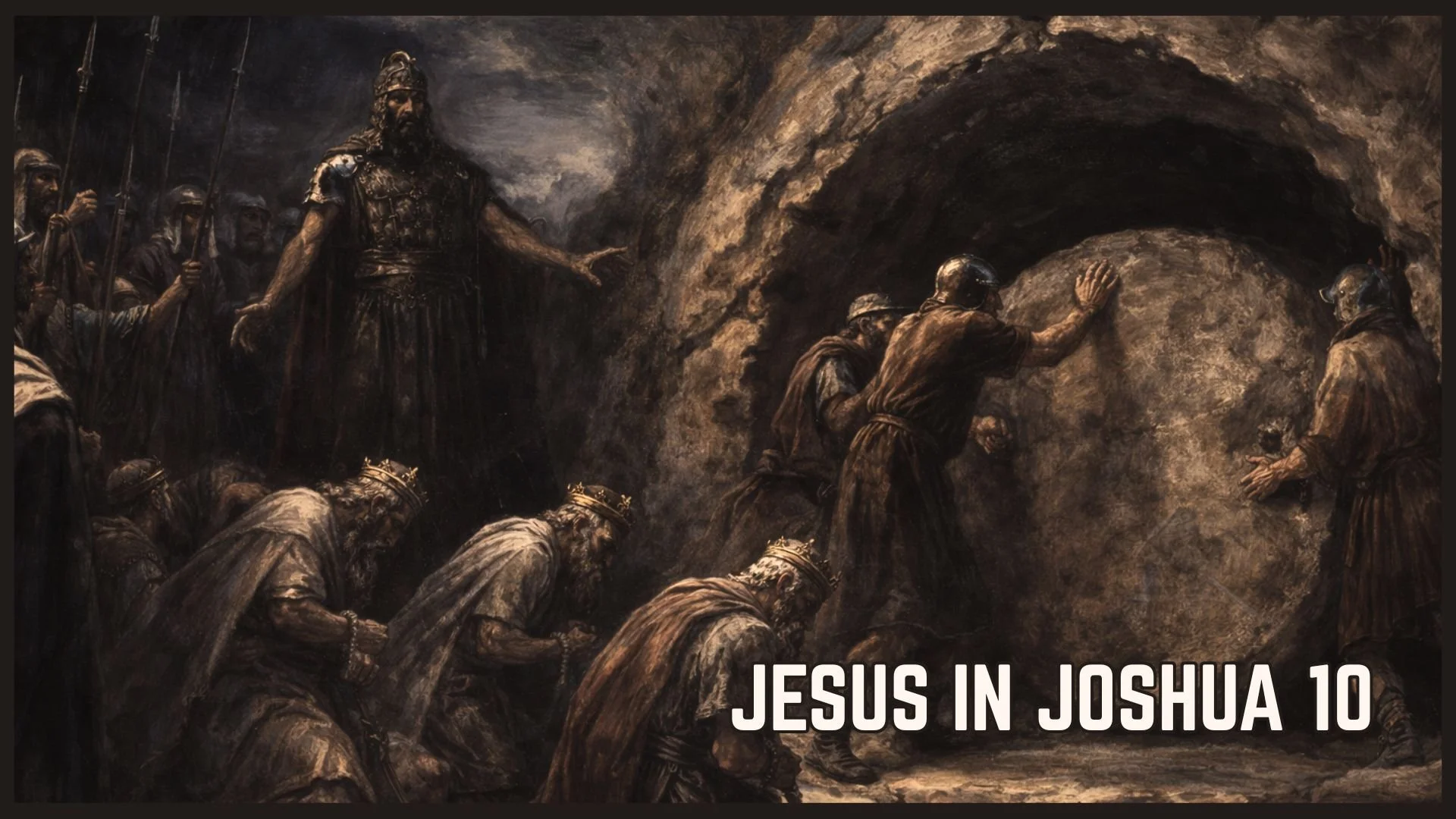
Joshua 10, the Kings Against God’s Kingdom
Joshua 10 records the defeat of a coalition of five Amorite kings who rose up against Israel under the leadership of Adoni-zedek, the king of Jerusalem. After their defeat, Joshua orders their execution and burial:
And afterward Joshua struck them and put them to death, and he hanged them on five trees. And they hung on the trees until evening. But at the time of the going down of the sun, Joshua commanded, and they took them down from the trees and threw them into the cave where they had hidden themselves, and they set large stones against the mouth of the cave. (Josh 10:26–27)
Adoni-zedek’s name is itself a theological title. Adoni is a common ancient Near Eastern title meaning “lord,” found in multiple languages beyond Hebrew. Zedek means “righteousness,” a term associated not per se with ethical uprightness, but points to his divine approval—by his own gods, not Yahweh, God (consider also Melchizedek, “king of righteousness,” who earlier ruled in Salem (Jerusalem) and ruled as a priest-king who blessed Abraham, Gen 14:18; cf. Ps 110:4; Heb 7:1–2). Adoni-zedek, then, presents himself as a “lord of righteousness,” ruling from the city whose name is peace (Jerusalem, land of peace), yet in open rebellion against Yahweh and Yahweh’s people.
The city of Jerusalem retains its pre-Israelite name after the conquest, likely because its meaning aligns with the theological vision of the land that Yahweh was establishing for His people. While Zion is also used as a designation for the city (2 Sam 5:7), Jerusalem has always been the dominant name in Israel’s story, perhaps because the Canaanite presence was not fully removed (Judg 1:21) and the name was never forgotten.
In the Greek translation of the Old Testament (LXX, Septuagint), these names are transliterated rather than translated. Adoni-zedek appears as Adonibezek, Jerusalem as Ierousalem, and Joshua as Iesous. This is not incidental. Yehoshua (“Yahweh saves”) is transliterated as Iesous in Greek, which then directly gives rise to the New Testament name Jesus (See “What is Jesus’s Real Name?” for more details on this topic). The same name patterns Joshua, the leader who brings Israel into the land, onto Jesus, the one who brings God’s people into their final inheritance (Heb 4:8–9).
Inverted Typology Points to Christ
This sets up an “inverted typology” between Joshua and Jesus. In Joshua 10, the “lord of righteousness” rises up against the true righteous Lord. Adoni-zedek and his allied kings are defeated, hidden away in a cave, and sealed behind a stone “door.” They are brought out alive only to be humiliated and executed, with Joshua commanding his leaders, “Put your feet on the necks of these kings” (Josh 10:24), an image depicting the removal of authority and the end of their kingdoms (cf. Ps 110:1).
In the Gospels, the pattern is reversed. Jesus is the true Lord of righteousness, yet he is opposed by the leaders of Jerusalem, those who reject him as Messiah (John 1:11; Matt 23:37–38). Unlike the kings in Joshua, Jesus enters the tomb dead, not alive. A stone is rolled against the entrance, and guards are stationed to secure it (Matt 27:60–66). Yet instead of emerging to judgment and death, Jesus rises to indestructible, eternal, and glorified life, “He is not here, for he has risen, as he said” (Matt 28:6). The cave is a symbol of shame and finality for the kings of the earth, but in Jesus’s humility unto death, “God has highly exalted him and bestowed on him the name that is above every name, so that at the name of Jesus every knee should bow, in heaven and on earth and under the earth, and every tongue confess that Jesus Christ is Lord, to the glory of God the Father” (Phil 2:9–11).
Joshua’s conquest climaxes in the public shaming and destruction of the kings of the land. Jesus’ resurrection climaxes in the public vindication of the King of God’s kingdom. Where Joshua’s enemies are trampled and destroyed, Jesus’ enemies are exposed and disarmed through his death and resurrection (Col 2:15). Where Joshua establishes God’s rule in Canaan, Jesus establishes God’s eternal kingdom, a reign that cannot be shaken (Dan 7:13–14; Rev 11:15).
Kings and Empires in Biblical Theology
This pattern fits within the broader biblical imagery of kings and empires. In Daniel’s visions, he sees the kingdoms of the earth as beasts that rise up to rage against God and his Kingdom, and are ultimately judged, while dominion is given to the Son of Man who rises on the cloud to the right hand of the Ancient of Days and to the saints of the Most High God (Dan 7:21–27). This theme continues quite directly in Revelation, depicting the kings of the earth brought low while Christ reigns forever as “King of kings and Lord of lords” (Rev 19:16).
Typology and symbolic patterning can be tricky. We observe an inverted type, as in the previous section, followed by a consistent pattern within the same narrative, as here. Joshua and Jesus are not, themselves, opposites, but Joshua (Jesus’s namesake) is a prototype of Jesus. The narratives progress in continuity. Both Joshua and Jesus put the kings of the earth to shame and established the reign of God. Joshua does so provisionally, in the land of Canaan. Jesus does so finally, in the renewed and eternal land promised from the beginning (Rev 21-22). The same name identifies both figures, but the greater Joshua completes what the first typologically foreshadows. In this way, the Old Testament conquest narratives demonstrate God's eternal promises to his elect saints.
