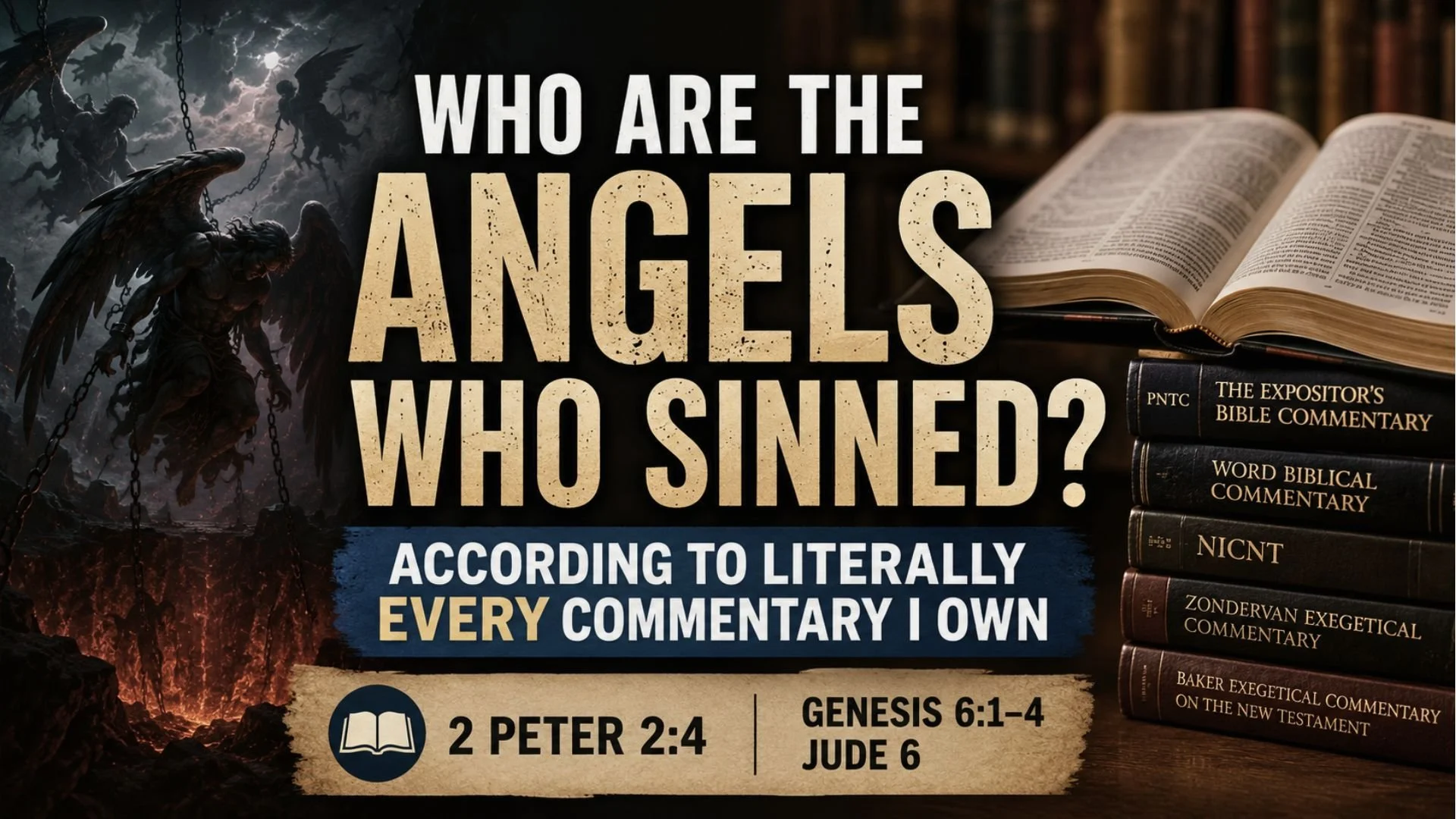
Who are the angels who sinned according to literally every commentary I own?
In my video Theopolis vs. Heiser: The Divine Council Debate Explained, I examined Christopher Kou's critique of Michael Heiser's Divine Council Worldview. One of their key disagreements concerns Genesis 6:1–4. Kou rejects the traditional angelic interpretation, arguing instead that the passage describes human cultic unions. I argued that the supernatural reading is the most natural interpretation of the text, fits the broader biblical and Second Temple context, and is reflected in the way Peter and Jude read Genesis 6. In response, a viewer commented, "angels who sinned is a reference to Genesis 6? Really? That's a stretch bro." Since this objection was not an argument from the text but an assertion that the connection is implausible or idiosyncratic, I decided to investigate how commentators from across a broad spectrum of Christian traditions understand 2 Peter 2:4 and whether they connect it to Genesis 6:1–4.

The Unseen Battle: Spiritual Warfare, the Three Rebellions, and Christ’s Victory Over Dark Powers (by Joel Muddamalle)
In his book, The Unseen Battle, Joel Muddamalle develops the concept of spiritual warfare through the Bible’s supernatural worldview. The book explains why the world looks spiritually fractured, politically chaotic, and morally contested. The book is a biblical-theological work, solidly grounded in Scripture and the Ancient Near Eastern (ANE) context. Muddamalle organizes the story of spiritual warfare around a supernatural framework of God’s supernatural and human families. He further explores how the relationship between these two households informs the narrative of conflict, rebellion, and redemption in the biblical text. The goal of The Unseen Battle is to bring understanding of the powers at work in the world and to highlight the order brought through Christ’s victory over all things.
Monotheism and the Divine Council
In conservative theological circles, the term divine primarily refers to God (the Trinity or the Godhead) as the ultimate, supernatural reality. But in historical usage, the term can be used to describe that which proceeds from God (like Jesus’s nature or the Holy Spirit’s work) or, in biblical contexts, figures in God's heavenly council (angels, etc.) as “divine” or “sons of God,” though these beings are clearly not God Himself. Divinity, broadly speaking, then, denotes something of God’s nature, essence, or involvement in his nature or essence, distinguishing it from mere human goodness or the gods of other faiths, while still acknowledging divine attributes in created beings, such as angels and divinized humans.
The Divine Council Worldview (DCW)
The Divine Council Worldview (DCW) posits that a heavenly assembly of spiritual beings exists under the authority of the supreme God, both ordering the cosmos and human destiny. Its origins are seen in ancient Near Eastern religions such as Mesopotamian, Egyptian, Canaanite, and Hittite traditions, which depicted divine assemblies governing the world. The Bible engages with this worldview, describing God’s appointment of the nations to spiritual rulers, their subsequent rebellion, and God’s ultimate judgment over them. Key themes include the reality of lesser elohim, the hierarchy of heavenly beings, and the compatibility of the DCW with biblical monotheism. Ultimately, the Scriptures use divine council language to demonstrate Yahweh’s unrivaled supremacy over all spiritual powers.