Where does it talk about giants in the Bible?
How big are ancient giants?
(Archeological and Literary Evidence for Ancient Giants)
Biblical references to giants appear frequently as both named individuals and entire people groups, indicating that extraordinary human size was a recognized feature of the ancient world. Although many supposed archaeological discoveries of giant remains have been exposed as fraudulent, literary testimony and rare cases of extreme human height suggest that unusually large individuals did exist and would have been perceived as formidable in antiquity. Comparisons between biblical measurements (especially those related to Goliath) and known historical examples show that the described heights fall within the upper range of human possibility. More importantly, the giant traditions serve a theological purpose: they illustrate the link between supernatural rebellion and human tyranny and frame the broader biblical theme of spiritual warfare. Minimizing or dismissing the reality of giants risks flattening the Bible’s supernatural worldview and obscuring the larger conflict between the forces of God and the powers of evil that runs throughout the biblical story.
It’s no secret I like to talk about the fantastic and mythical elements of Scripture. But this video isn’t just for fanaticism. I’m not going to talk about giant myths for 30 or so minutes because people like to dream about fanciful things. No, I’m more interested in reading the biblical narrative. And I want to get into the real evidence for giants today as well.
On one hand, you might say it doesn’t matter how big the giants were, or even if they existed in the first place. But, as we analyze archaeological and literary evidence from the ancient world, the answers to these questions help us understand the biblical worldview and point us toward some important theological ideas.
Namely, biblical giants are, well…giant…and if you try to make them small, you miss something incredible about the biblical story and the biblical worldview.
So, we’ll geek out a bit on some of the fun stuff first. And then we’ll have the context to answer the question about why giants matter in the Bible.
But first, if you like discussing the enchanted corners of the Bible, please like and subscribe. But also, head over to anthonydelgado.net and check out my books, articles, and other free materials—and grab a free gift over there for signing up for my mailing list.
OK, let's get to giants:
Where does it talk about giants in the Bible?
I want to quickly go through the specific giants mentioned, just so you see how often this comes up. And this isn’t every reference, just the big obvious ones.
Goliath is the most famous giant, a Philistine from Gath who was killed by David (1 Samuel 17).
Og, King of Bashan, was the last of the Rephaim, whose bed was over 13 feet long (Deuteronomy 3:11).
Ishbi-Benob was the giant warrior who tried to kill David (2 Samuel 21:16).
Saph (or Sippai) was a giant slain by Sibbecai the Hushathite (2 Samuel 21:18).
Lahmi was the brother of Goliath, slain by Elhanan (1 Chronicles 20:5).
An unnamed Warrior with six fingers and six toes on each hand/foot was killed by Jonathan (2 Samuel 21:20).
Anak, from the Nephilim, appears to be a giant according to Numbers 13:33.
Groups and Tribes of Giants
The Nephilim are mentioned twice in the Bible, in Genesis 6 before the flood and later in Numbers 13:33.
(Sons of Anak, already mentioned): A race of giants encountered by spies in Canaan.
Rephaim is both a general term for ancient giants east of the Jordan and, at least once, a reference to a tribe of people, perhaps a tribe of giants or a tribe with many giants.
The Emim are described as “terrors” as tall as the Anakim (Deuteronomy 2:10-11). Note, “they are also counted as Rephaim [giants], but the Moabites call them Emim.”
The Zamzummim (or Zuzim) are a tall tribe living in the land of Ammon (Deuteronomy 2:20-21)—also called Rephaim or giants.
Finally, the Amorites are described as having great height like a cedar and strength like oaks (Amos 2:9).
With all these mentions of giants in the Bible, not to mention in nearly every ancient culture, we should expect to find archaeological evidence of giants. And we do! Yet, many ask:
Are giant discoveries fake?
The answer is, some of them, yes. Perhaps most of them, especially if we’re talking about bones. But there is other evidence.
Look at this entry on giants from the 1891 Cyclopædia of Biblical, Theological, and Ecclesiastical Literature. (NOTE: published in 1891, this is 135 years old!)
The general belief (until very recent times) in the existence of fabulously enormous men arose from fancied giant-graves (see De la Valle’s Travels in Persia), and, above all, from the discovery of huge bones, which were taken for those of men, in days when comparative anatomy was unknown. Even the ancient Jews were thus misled (see Josephus, Antiquities). Augustine appeals triumphantly to this argument, and mentions a molar tooth which he had seen at Utica, a hundred times larger than ordinary teeth (see City of God). No doubt it once belonged to an elephant. Vives, in his commentary on the place, mentions a tooth as big as a fist, which was shown at St. Christopher’s. In fact, this source of delusion has only very recently been dispelled. Most bones which have been exhibited have turned out to belong to whales or elephants, as was the case with the vertebra of a supposed giant examined by Sir Hans Sloane in Oxfordshire. On the other hand, isolated instances of monstrosity are sufficiently attested to prove that beings like Goliath and his kinsmen may have existed.
Even 135 years ago, they were able to identify and expose fakes. Yet they found sufficient evidence in the literary record and other archaeological finds to believe that giants did indeed exist.
Faking archaeological finds is not a new venture, though. Archaeology was formalized as a scientific discipline during the mid-to-late-19th century. Up to this point, fakes were popping up all over the place (and still do).
You see this in movies and stuff: traveling exhibitions that feature relics, curiosities, and various oddities—most of them, actually, fakes. They were sometimes called sideshows, “Museum Shows,” or “freak shows” when they featured live performers, as well as fabricated ones, like the Feejee Mermaid. Think about the P.T. Barnum dime shows, for example — I just watched The Greatest Showman again, so that’s fresh in my mind.
And this still happens when we’re not paying attention: For example, after the first discovery of the DSS, fakes started to turn up and continued to turn up well into the 2000s (perhaps still do today, IDK). So many of these have turned out to be forgeries that it’s been called a “forgery epidemic.” It’s a complete phenomenon. I was out at DTS, and they have a forgery on display in their library—marked as a forgery, but there are so many forgeries that it makes for a nice display piece to warn us about the danger of this sort of thing. I was almost as excited about the forgery as I was when I went to see the actual DSS.
An older example related more to human remains is the Piltdown Man, a famous 1912 archaeological hoax consisting of a human cranium and an orangutan jaw with filed-down teeth, presented as the “missing link” between apes and humans. It wasn’t exposed as a forgery until 1953.
So, the lesson is: you can’t trust everything.
But don’t miss the conclusion, even though so much of the giant evidence is fake, “isolated instances of monstrosity are sufficiently attested to prove that beings like Goliath and his kinsmen may have existed.” That is, there is evidence for giants, just perhaps not as much as we want to secure conclusive results. But such is the nature of archaeology. Most of human history has been lost to decay and destruction. Our history is fragmentary, at best.
In archaeology, a lack of evidence is never evidence that something didn’t exist.
OK, so if we think there is enough evidence to say giants may have existed, and certainly we see a great deal of evidence in the Bible itself, the next thing we want to know is…
How tall were ancient giants?
I’d like to read from Michael S. Heiser’s The Unseen Realm, pages 211-213:
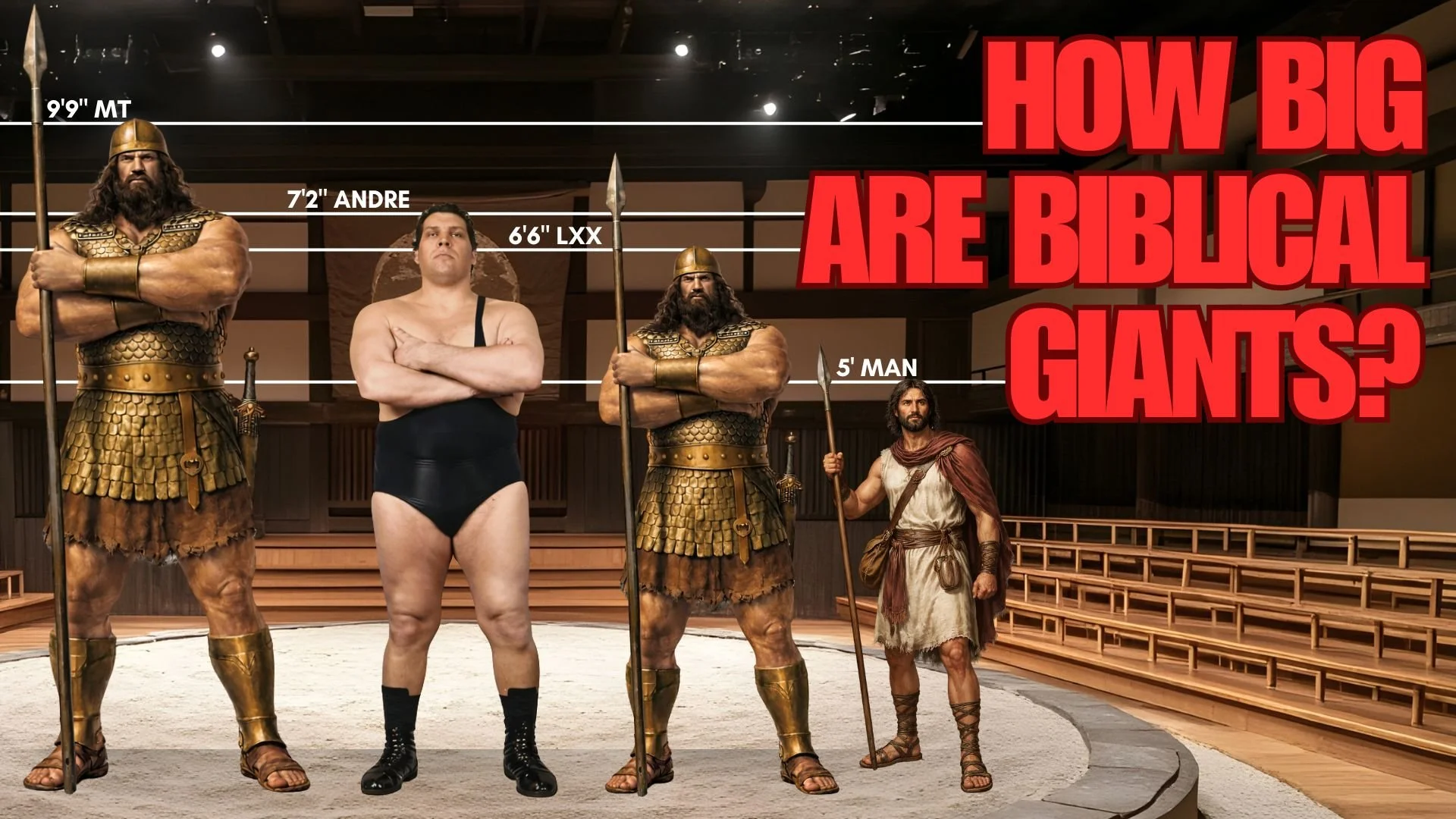
The only measurement for a giant that exists in the biblical text is that of Goliath. The traditional (Masoretic) Hebrew text has him at “six cubits and a span” (1 Sam 17:4), roughly 9 feet, 9 inches. The Dead Sea Scroll reading of 1 Sam 17:4 disagrees and has Goliath at four cubits and a span, or 6 feet 6 inches. Virtually all scholars consider the Dead Sea Scrolls reading superior and authentic.
Archaeological work across the ancient Near East confirms that six and one-half feet tall was, by the standards of the day, a giant. One scholar of Israelite culture notes that the average height of an ancient Israelite in the patriarchal period was around five feet…The ancient Israelites, like other peoples of Canaan at the time, did not embalm their dead. Consequently, human skeletal remains from the first two millennia BC are not common. Of the millions of people that lived in ancient Syria-Palestine during that two-thousand-year span, a few thousand skeletons have survived.
But notice what Ronald F. Youngblood says in NIDOTTE, entry on giants:
Equally impressive statistics are attested for other Rephaites and assorted giants. spearhead weighed seven and a half pounds (2 Sam 21:16). An unnamed Rephaite was “a huge man with six fingers on each hand and six toes on each foot” (2 Sam 21:20). Lahmi, Goliath’s brother, was so big that he had a spear with a shaft “like a weaver’s rod” (1 Chron 20:5). Benaiah son of Jehoiada struck down an Egyptian who was seven and a half feet tall (1 Chron 11:22–23). Goliath himself was “over nine feet tall” (1 Sam 17:4). ← You’ll notice Heiser disagrees with that height, favoring the LXX, 6’ 6”
The question many ask here is: Should the Bible’s descriptions of the unusual height of the Rephaites and other giants be taken literally or figuratively? Youngblood asks:
Is it necessary to assume that the attribution of great size…“was…a narrative way of expressing their military prowess”? Hardly. Even the account of Goliath’s height is paralleled in modern times by reports concerning R. P. Wadlow, who was eight feet eleven inches tall at the time of his death on July 15, 1940, at the age of 22. Nor is it true that “there are no remains [skeletons and the like] of any aborigines of abnormal size.” Skeletons 3.2 meters tall have “been excavated in Palestine.”
Here’s the interesting thing on this one. I didn’t have access to Youngblood’s source for the 3.2-meter skeletons, and if you Google it, you’re told it’s just internet fanaticism. But NIDOTTE is a scholarly, peer-reviewed dictionary. What I suspect is happening here is that legitimate evidence is getting lost in a sea of fabrications. You know, some folks are holding out for giant skeletons measuring 30 or 100 feet to be found. The point here is that the biblical record describes giants of a size that is not so foreign to the archaeological record and well represented among modern people. One such example is Andre the (so-called) giant. So…
How tall was Andre the Giant?
André the Giant was famously billed at 7 feet 4 inches tall during his wrestling career. While often touted at this height by the WWE, his actual, verified peak height was closer to 7 feet 1.6 inches or 2.2 meters. You might not think that’s big because we have basketball and a worldwide media network that normalizes people of this height. Gheorghe Mureșan and Manute Bol are the tallest NBA players in history at 7'7", followed by 7'6" giants Yao Ming, Shawn Bradley, and Tacko Fall. But realize, we don’t run into people this size, basically ever. The tallest people I know are in the mid-to-low 6’ range.
Back to Andre: he weighed in at around 520 lbs. More impressive was that Andre was immensely strong: He was often described as “superhuman,” an intriguing claim that suggests he was “beyond human” (cf. the origin of the Nephilim in Genesis 6). He was known for deadlifting over 2,000 lbs, bending heavy steel bars, and casually overpowering multiple wrestlers in tug-of-war. Andre moved cars and lifted grown men with ease, using raw power. He was even billed as the Eighth Wonder of the World.
NOTE: His stature was due to gigantism, a result of excess growth hormone. People want to say that makes him different than biblical giants who have a supernatural origin. I’d respond by pointing to the creation of Adam and ask, who in existence doesn’t have a supernatural origin. We all do, and that doesn’t change the reality of our biology. So, having a biological reason for existence actually points to a supernatural source; it doesn’t stand in the way of it.
I think a better argument—if you want to say he’s not like the biblical giants—is that Andre was hardly a tyrant like the giants of ancient myths. And this is a question for another day, but it’s not being a giant that makes a tyrant; it’s being under the influence of demons that makes a tyrant. So not every human bearing giant blood need be a tyrant, particularly if they’ve been given over to the Holy Spirit. And in this case, that seems likely. Andre the Giant (by birth, Andre Rene Roussimoff) was raised in the Catholic faith. He was born in France to Bulgarian and Polish parents and grew up in a traditional, religious household within the broader Christian tradition. Interestingly—if you know my work in sacramentalism, I’d argue this is right—a “minor exorcism” is a standard part of the Catholic baptismal rite and could be said to explain his gentle nature, given his giant stature.
Getting back to the Israel narrative in the Bible:
Who cares how big the giants were (or are) anyway?
As a point of analogy, let’s briefly reflect on Andre. He was billed at 7’ 4,” but that was 1.5 inches taller than he actually was. But for some reason, they made the marketing decision that 7-4 sounded much bigger than 7-2. A bigger giant means bigger appeal.
Here’s what’s odd: Usually, the Greek text leans towards the more fanciful interpretation, but in this case, it takes the 9-9 giant of the Hebrew text all the way down to 6-6. As discussed, Heiser says, “yeah, but that’s still really big if the average Israelite man was only 5-foot.” And that’s true. And it does put the biblical giants into a framework that’s a bit more workable, since we have evidence from Andre and a number of other really big people. But we have a record of men up over 9 feet as well, so that’s not really the issue here.
What I’m really concerned about is our tendency to say 30-foot giants are out of the question, then look at 9’ in the Hebrew text and say, “well maybe,” but then look at the 6-6 giants of the LXX and go, “yeah, I can believe that.” My question is, Why are you having a hard time believing in supernatural realities? There is a clear trajectory away from the supernatural or enchanted view of the Scriptures in modern society. And that’s my problem. I’ve spoken of this in many other places: disenchanting the Scriptures damages our faith and, quite literally, destroys our ability to interpret them properly.
But let’s just briefly look at the narrative issue here and see what we lose: Genesis 6:1-4. Divine beings leave their home in heaven (Jude 6) and sin by having children with human women. Those children are the Nephilim: giants, mighty warriors. Genesis 6:5. The wickedness of giants spreads to all humankind, resulting in the flood. Job 26:5, Psalm 88:10, Proverbs 2:18, 9:18, 21:16, Isaiah 14:9, 26:14, 26:19. Disembodied spirits called rephaim (giants) or shades are described in opposition to God and to his goodness. Gospels. Demons, or disembodied spirits, take control of humans to make them do things that are wicked on the earth, and Jesus heals these people by casting the demons into the abyss. James 2:19. The demons shudder in fear before God. 1 John 4:1–3. Demons oppose the doctrine of the incarnation. This is really interesting because the incarnation is God embodied in human flesh. But demons try to unnaturally embody human flesh, contrary to God’s will. And of course, there’s much more that could be said in the NT about demons and the forces of darkness, but in the end, the Devil and his angels, and all demons are cast into the lake of fire.
The giants are the beginning of the narrative of spiritual warfare. They depict how spiritual rebellion leads to tyranny on the earth. If we understand the spirits of giants this way, then there are giants all over the place, in anyone who gives themselves over to the devil at the crossroads, so to speak. See, giants aren’t so much about physical size, but about spiritual war. But if we make the giants in the Bible too small, we make our understanding of the demonic too small. And you start to see the empires of the world as morally neutral or human necessities, when the Bible continually portrays them as the beast, controlled by the whore of babylon as they drink from the cup of her immorality and are led astray, the way of demons.
My channel is about recovering the Bible’s supernatural worldview—reenchanting the Bible. And people want to know why I care so much about giants. And that’s my answer. They’re all around us; let’s not be blind to that reality. Thanks for listening; please like and subscribe.
Christ is King, and that changes everything.
